Hello fellow readers!
I recently finished and made progress on some courses.
Python
First things first - I got to the 4th section of the Python Bootcamp Udemy course.
I learned what are strings, lists, dictionaries, sets and tuples. I made it through the first assessment about objects and data structure (which was ungraded and had infinite tries) and treated like a real test, which means that I answered all the questions before looking at the answers. — I know, it feels obvious to test yourself like that but I admit I rarely do it, and seek answers almost instantaneously when I get something wrong, but the Huberman video I’ll talk about below made me change my mind.
I felt quite surprised by the amount of answers I got right, I thought I'd get most of it wrong - guess I do have impostor's syndrome 99% of the time, which is pretty annoying and overkill to my mental health tbh.
I'm very excited for what's next, looking forward learning about python methods and finding out how and where I can apply this knowledge. I've been thinking about implementing this on the domestic organization plans and ideas that I told you guys on the last post, but I have yet to build a bridge between those two.
Learning about learning
One thing I really want to share after talking about "real tests" and connecting ideas is this video on learning from Huberman Lab. There's a lot of data presented in this video related to studying.
I got some favorite parts from this video:
The first one is related to neurons and how the strengthening of existing connections is what makes us "learn better". This one is at 00:08:22 Learning & Neuroplasticity. I love this because it makes sense to what Henri Bergson says on Matter and Memory about the effectiveness of our perception. It is about the amount of "images" that reflect upon themselves and to our body, those being taken every time we perceive something new about the matter.
The second was finding out about the importance of timing for tests. Did you know that when you take a test right after you learn something, have a gap and then another test later, the knowledge retainment is much higher? If you want to jump to that point, go to 00:48:23 Self-Testing, Repeated Testing.
The third is something that I hate but I know it's true - learning is difficult. If it feels too easy, you're probably not learning! Ha!
And the last one — finding out that re-reading is not the best choice to learn something, testing is actually more effective. This was very important to me because I was just re-reading Henri Bergson’s Matter and Memory (which is a really dense book) and decided to reread just the summary instead. This made more sense since the summary is written by the author and it is the last chapter of the book. And believe me, it did feel more effective to remember those concepts this way instead of re-reading the whole thing. I’m excited to revisit more of Bergson’s books and maybe come up with some videos for you to understand why I like his ideas so much - and to test myself on this subject.
OpenUSD
So, the OpenUSD course - this is the one I told you guys about on the last log when I said exciting stuff were coming from the Study Group. Last week they launched it officially. Click here to access the whole OpenUSD learning path. It is primarily meant for developers/programmers, but if I can learn something from it, you can too!
Anyways, I got through the first module that presents some foundational concepts of USD and how to work with it using python.
I thought I should challenge myself to do something with code on my own for the first time, so I did. I decided to try traversing an existing stage (Pixar's Kitchen scene) by using this code from the course's Jupyter Notebook:
file_path = "assets/second_stage.usda"
stage: Usd.Stage = Usd.Stage.Open(file_path)
for prim in stage.Traverse():
print(prim.GetPath())
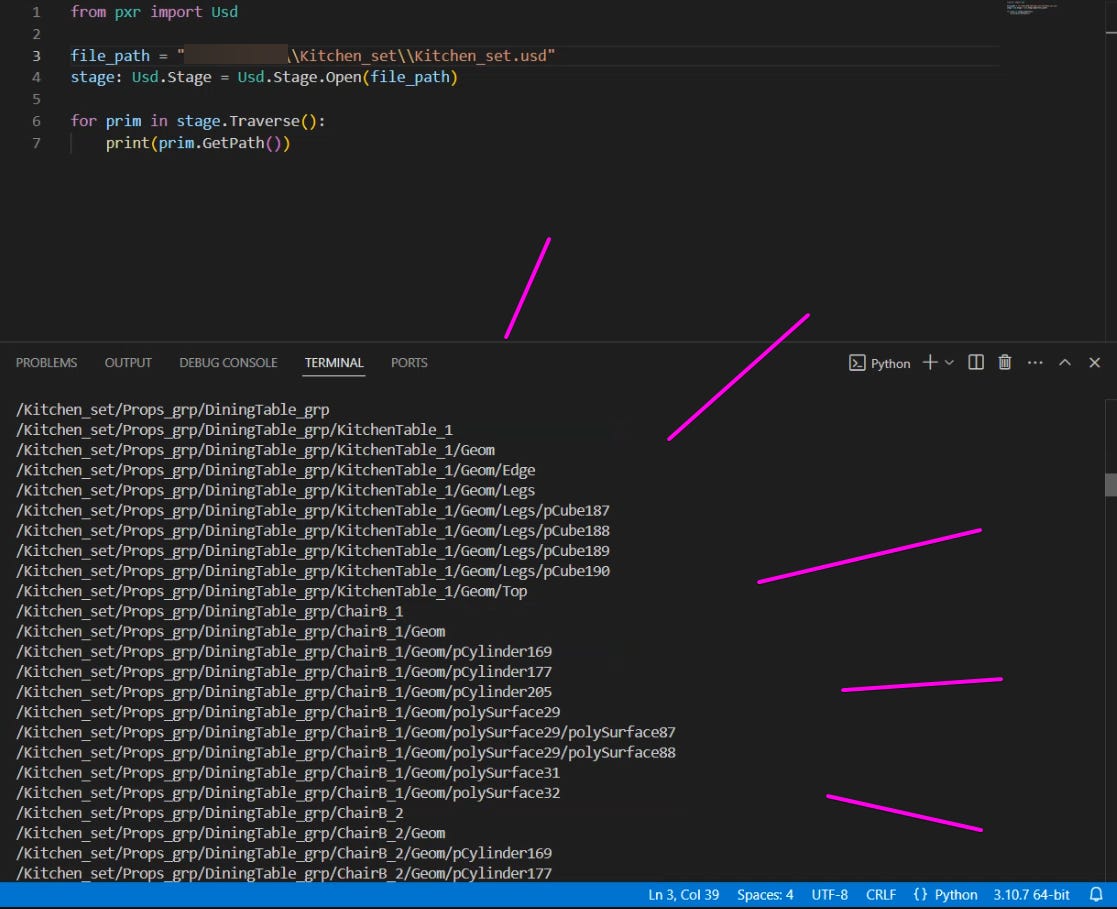
I got what I wanted, which is the hierarchy of prims inside the stage.
So, I figured I'd try the same with Alab, but this time, it didn't work. I spent around 45 minutes searching for the error - which I thought it was the python version (I was on 3.12, not 3.10) - but after sharing this problem with the Study Group it seems this might not be the issue.
Anyways, after a while I managed to get this code working again, but I admit I'm more confused now than before. It doesn't make sense to me yet why it stopped working after the first time I tried it.
It was recommended to me that I installed the USD python libraries from this page, so I'll try that when I get the chance and share my insights with you later.
Maya Camera Techniques
This was the first LinkedIn Learning course I bought and completed. I have to say I'm surprised about the overall quality of this platform.
The teacher, Aaron F. Ross, is quite knowledgeable on Maya and gives tons of tips throughout the course. My favorite one was finding out that motion trail handles can be activated on the viewport - but that's just one of them. He also brings dozens of helpful keyboard shortcuts and other helpful tips to make your creative work in Maya more technically polished.
The videos are generally short and concise, with in depth explanations and no deviations of the topic at hand. And the notebook is very handy, and allows you to quickly make notes on-the-go during the videos. You can also export those notes later in a txt file.
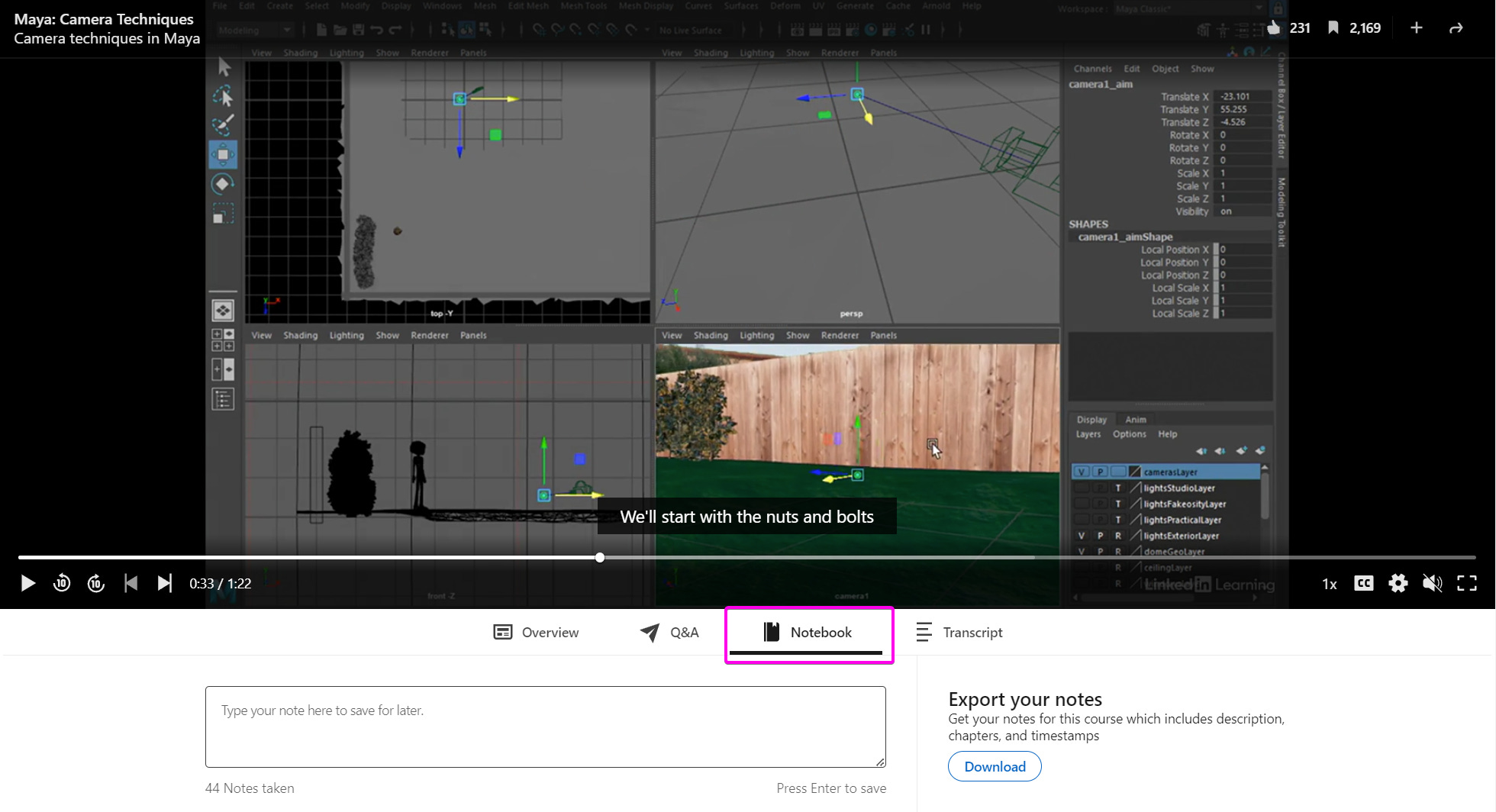
This course is very helpful to those who are layout/previs artists or animators, or have interest in learning more about the topic. I highly recommend it. You even get a fancy certificate of completion afterwards!
Unfortunately I’ll be quite busy this week, so I don’t know when the next log will be, but thank you for reading!
You’re welcome to join the OpenUSD Study Group every Tuesday at Nvidia Omniverse Discord Server.
You can also accompany ASWF Working Group(s) meetings and discussions by having a look at their page and calendar.
Please share your thoughts and opinions at the comments section or the chat! :D